
AI is rapidly becoming a commonplace tool in online retail. AI is becoming a pivotal tool for eCommerce businesses as they strive to optimize various aspects of their operations, from supply chain planning and customer service to pricing, marketing, fraud detection, and delivery management. As this change takes place, new opportunities are emerging for retailers, and others who've taken a longer approach to modernizing their operations are finding that they are under pressure.
The website improvements, mobile shopping, digital payments, and faster delivery have been the driving force behind ecommerce growth for years. Currently, AI is emerging as a key driver of operational efficiency. Retailers can crunch massive amounts of customer and business data in a matter of seconds, helping teams to find patterns that might otherwise take hours or days to find.
Tackling the challenges of AI beyond the realm of customer recommendations.
One of the first applications that emerged from AI was product recommendations. Product recommendations were one of the initial applications to come out of AI in the online retail sector. Its job is growing significantly now. AI-driven systems are helping retailers predict customer demand, uncover buying patterns, fine-tune product catalogs, and tailor online experiences.
AI can provide businesses with insights on which products are likely to be popular, which customers might be ready to buy again, and where inventory might be running low. This can enable retailers to make decisions with real-time data and not just rely on historical reporting.
As generative AI becomes more prevalent, content will be impacted as well. Retail teams can use AI tools to assist with product descriptions, promotional content, customer emails, social media material, and internal communications. While human intervention is still essential, these tools can help save time on repetitive content tasks.
Smarter Inventory Management Becomes a Priority.
One of the main issues in e-commerce remains inventory management. Having too much stock can lead to higher storage expenses, and low inventory can lead to lost sales and unhappy customers.
Sales data, seasonal trends, customer behavior, promotions, and other business indicators can all be analyzed using AI-powered forecasting tools to help retailers forecast future demand. This can provide a more flexible approach to stock planning and help to minimise excess stock.
This is especially useful for companies that are expanding their ecommerce operations. Retailers increasingly link inventory management with sales and marketing and financial and supply chain data, rather than keeping it as a distinct administrative function.
Customer Service Transitions to a New Era.
AI is also transforming the way online retailers interact with customers. Chatbots and virtual assistants can deal with fundamental orders, shipping, returns, product knowledge, and account questions.
One does not have to get rid of human customer service teams altogether. Rather, AI can handle repetitive requests, freeing up employees to deal with more complex cases that need judgment and an individual touch.
Retailers who can respond quickly and accurately to digital interactions may enjoy a competitive edge, as consumers get used to the faster interactions. But sub-optimal AI systems can lead to frustration if a customer can't get a human operator if they need one.
Pricing and Fraud Detection supported by AI.
The other facet of the discussion that is gaining traction is dynamic pricing. By examining market trends, demand, competitor behavior, and customer patterns, AI can assist retailers in making informed pricing decisions.
The sophistication of fraud prevention is also increasing. Online retailers conduct thousands of transactions, making it challenging to manually flag suspicious transactions. AI systems can identify patterns in transactions and alert to unusual activity to be investigated.
These applications show how increasingly AI is becoming seen not just as a marketing tool but an operational technology too.
A Technology Gap is widening at the business level.
Larger e-commerce stores may be able to spend more to invest in AI, whereas smaller stores have other problems. There are various factors that can impact the speed of AI adoption within a business, including data quality, technology costs, employee skills, cybersecurity, and integration with existing systems.
The significance of the role of the expert is growing, with a new focus on the fact that the successful implementation of AI is not a matter of buying a new tool. Having accurate data, streamlined processes, robust security protocols, and trained staff who can employ AI effectively are essential for businesses.
These retailers are likely to be those that are more concerned with solving business challenges than just following the trend of AI.
What's Next For E-Commerce?
As technology becomes more accessible, AI in retail is poised to grow further. In the future, it could be possible to integrate customer experience, stock, logistics, marketing, and financial management more closely than ever before.
The competitive advantage may be the result of execution. AI and effective human decision-making can help retailers to be more efficient without compromising on customer trust. Without a proper technology strategy, those technologies which are adopted may not bring in any fruitful outcomes.
Conclusion
For online business teams, the bottom line is it's no longer a spectator sport. It is becoming an integral component of the operational framework that will influence the competition between online retail businesses in the modern world.
FAQs
1. How is the e-commerce industry transforming with the help of AI?
AI can be a retailer's ally when it comes to inventory forecasting, customer service, pricing, fraud prevention, marketing, product recommendations, and making business decisions.
2. AI can be utilized in small e-commerce businesses.
Yes. However, there are numerous AI-based platforms available, and they can be run with affordable software, so smaller businesses can use AI to automate some of their tasks without creating their own AI.
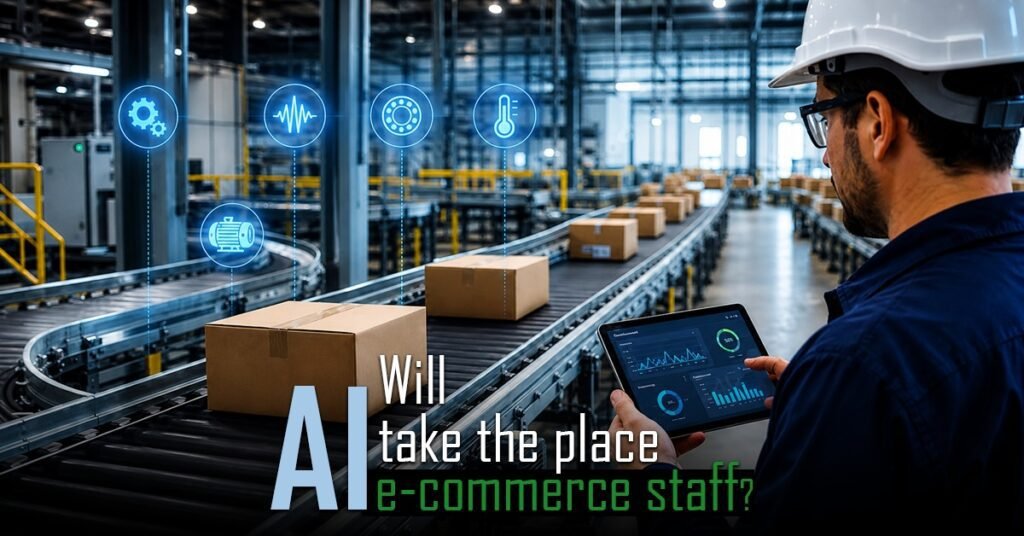
3. Will AI take the place of e-commerce staff?
While AI can handle repetitive tasks, humans are still crucial for strategy, customer relationships, creativity, and complex problem-solving.
4. How does AI assist with inventory management?
Through analysis of sales trends, seasonal demand, promotions, and other data, AI can assist businesses in predicting demand and optimizing their stocking strategies.
5. What are some factors for retailers to consider before implementing AI?
When choosing an AI solution, retailers must consider data quality, safety, integration needs, cost, employee training, and the particular problem or challenge they aim to resolve.