
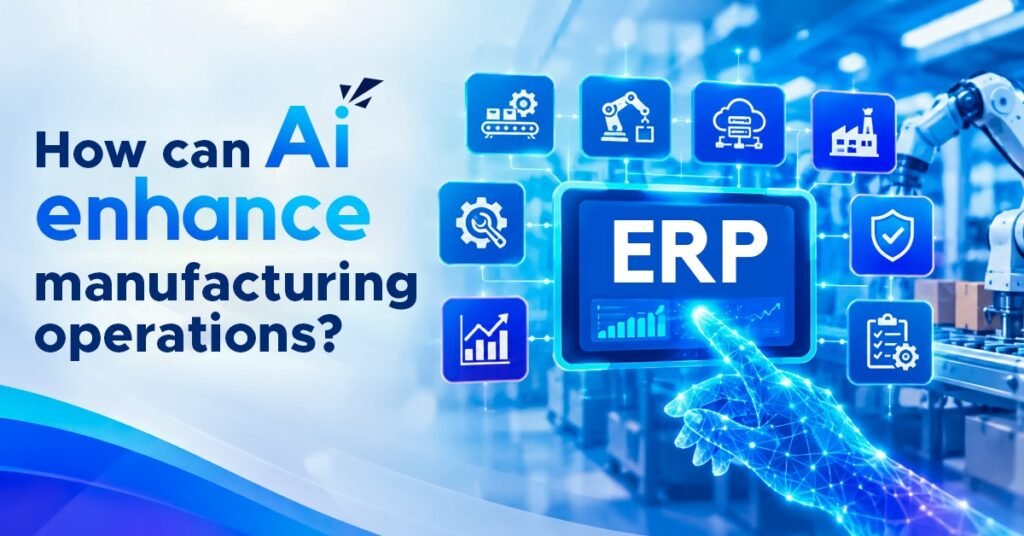
Artificial Intelligence is transforming ERP systems for Manufacturing businesses into more responsive, predictive, and efficient systems. AI-powered ERP systems can forecast demand, track inventory, pinpoint production problems, and aid in decision-making, among other functions.AI in manufacturing ERP can predict customer demand, manage inventory, identify production issues, and contribute to better decision-making, among many other functions.
Introduction
Manufacturing activities are an ongoing process that involves the movement of materials, machines, workers, orders, suppliers, and customer needs. These processes can all be manually managed and lead to delays, incorrect forecasts, overstocking, and manufacturing issues. Today, AI-powered ERP systems are tackling these challenges by integrating AI into day-to-day business processes.
AI-driven ERP systems are capable of analyzing vast amounts of data and detecting patterns, compared to traditional ERP systems that keep track of and organise information. This provides manufacturing teams with valuable data that can help them make quicker decisions and work more efficiently.
Smarter Demand Forecasting
Demand forecasting is one of the most helpful functions of AI within manufacturing ERP. Companies must be aware of the amount of stock and production capacity that will be needed, but not overstocking.
AI can review past sales and sales trends, and account for some other data available about the business to figure out potential sales trends. These insights can help manufacturers make informed decisions regarding production planning and minimize overproduction or shortage.
Predictive Maintenance for Equipment
Unexpected machine failures will throw off production schedules and raise operating expenses. With data from the equipment, AI-powered ERP systems can help with predictive maintenance by detecting patterns that are atypical for the situation.
Rather than sticking to a fixed maintenance plan, manufacturers can use data to inform them when equipment might need maintenance. By identifying potential issues at an early stage, businesses can plan maintenance activities and minimise unnecessary production downtime.
Better Inventory Management
AI can also enhance ERP solutions in inventory management.AI can also prove to be valuable in ERP solutions for inventory management. Manufacturers must have the correct amount of raw materials, components, and finished products at the appropriate time.
AI can process data on inventory flow, buying trends, manufacturing needs, and order history, and make informed decisions for businesses on stocking. This can help ensure more effective space utilization in the warehouse and minimize excess inventory expenses.
Improving Production Planning
For businesses that deal with several orders, resources, machines, and deadlines, production planning can be challenging. AI can sift through the information to provide insight into how production activities can be organized more efficiently.
Intelligent insights can help manufacturers understand capacity constraints and detect potential bottlenecks, then adjust schedules to meet evolving needs. This can help to speed up the teams' reactions to changing demand or production conditions.
Faster Business Decisions
The modern ERP system gathers data from various sections of a manufacturing company. AI can transform this data into valuable summaries, trends, alerts, and recommendations.
Managers can access detailed information on production performance, inventory, purchasing activity, sales trends, and operational issues without having to look at a huge volume of information manually. This enables quicker decision-making and maintains the relevance of important business information.
AI Solutions for Repetitive Tasks
AI can also help minimize repetitive administrative tasks. Automation can help with various routine tasks such as data entry, report generation, alert notifications, document processing, order-related workflows, etc., depending on the ERP system.
By minimizing manual tasks, staff can dedicate more of their time to tasks that involve human judgment, problem-solving, and communication.
Conclusion
AI is transforming the manufacturing function of ERP. Modern systems have broken free of the confines of mere transactional data and operational information storage. AI capabilities enable ERP systems to predict demand, track equipment, manage stock levels, enhance production planning, and transform business data into actionable insights.
When it comes to choosing an ERP system for an upgrade, it shouldn't be solely about the number of AI capabilities a platform provides. A more significant question is, do those capabilities address real-world problems and fit into the company's workflow?
FAQs
1. What is AI-powered manufacturing ERP?
Manufacturing ERP with AI is a blend of traditional ERP and artificial intelligence that uses AI to analyze data, automate processes, detect patterns, and assist in decision-making.
2. How can AI enhance manufacturing operations?
AI can be used for demand forecasting, inventory planning, predictive maintenance, production scheduling, reporting, and automation of repetitive processes.
3. Is there any possibility to prevent machine breakdowns using Artificial Intelligence?
By studying equipment and operational data, AI can detect patterns that could signal maintenance needs, alerting teams to potential issues before they arise.
4. Will AI replace employees in manufacturing?
AI mostly helps employees by automating repetitive tasks and giving insights. The role of human expertise is still relevant for planning, supervision, problem-solving, and strategic decisions.
5. What are the reasons for manufacturers to adopt AI-integrated ERP?
An AI-powered ERP can link all the operational data with intelligent analysis to boost visibility, adapt to changes, reduce manual tasks, and make better operational decisions.