
The property industry is moving into a new era of digital transformation, with property owners, developers, landlords and management companies more and more relying on software to steer the management of their complex operations. The once spreadsheet, paper-based, email and unconnected system is evolving to a technology-led workplace with integrated systems that can deliver property data, financial information, tenant communications and maintenance data.
As AI and automation increasingly play a role in property management, the change is gaining momentum even more in 2026. AI-powered property management solutions are more commonly adopted by the industry for repetitive administrative tasks, communication, document management, and workflow processes.
Seamless property software is becoming a necessity for a business.
A lot more than buildings and tenants is involved in managing a property portfolio. Businesses need to track the leases, rent payments, maintenance requests, vacancies, expenses, documents, compliance requirements, as well as financial performance.
The management of these tasks can be challenging using traditional approaches, especially with a growing portfolio. Duplicate information, delayed updates, and limited visibility of property performance can be a result of using separate spreadsheets and applications.
Nowadays, these activities are replaced and merged into a centralized digital space with the help of modern property software. Managers can keep records of properties, track occupancy, organize tenant information, and track financial activities from a single platform. This frees up teams' time to spend more on making operational decisions and less on information search.
How AI is transforming property management workflows.
The addition of artificial intelligence is one of the most significant advances in real estate software.
AI can provide assistance where there was a lot of manual effort. This encompasses answering everyday tenant questions, sorting maintenance requests, analyzing documents, producing reports, and finding trends in property information.
According to the research, AI-powered property management systems have evolved from simple chatbots to automation capable of performing operational tasks, which was published in 2026.
l The commercial real estate sector is also catching on to the use of AI agents. In May 2026, FORE Enterprise announced the launch of an AI platform featuring tools that will enable commercial real estate operators Pegasus to streamline tenant communications, minimise liability risks and facilitate property-tax management.
l This indicates an overall trend: software is no longer just about holding information; it's also about what it can do for businesses when it comes to taking action.
l Having good data can enhance property decision-making. Good data can help with good property decisions.
l A lot of information is created in the course of property management. Rental payments, lease dates, maintenance costs, occupancy rates, tenant requests, and financial records can all be used to learn about the performance of their portfolios.
The value of data is only realized when it can be effectively accessed and interpreted.
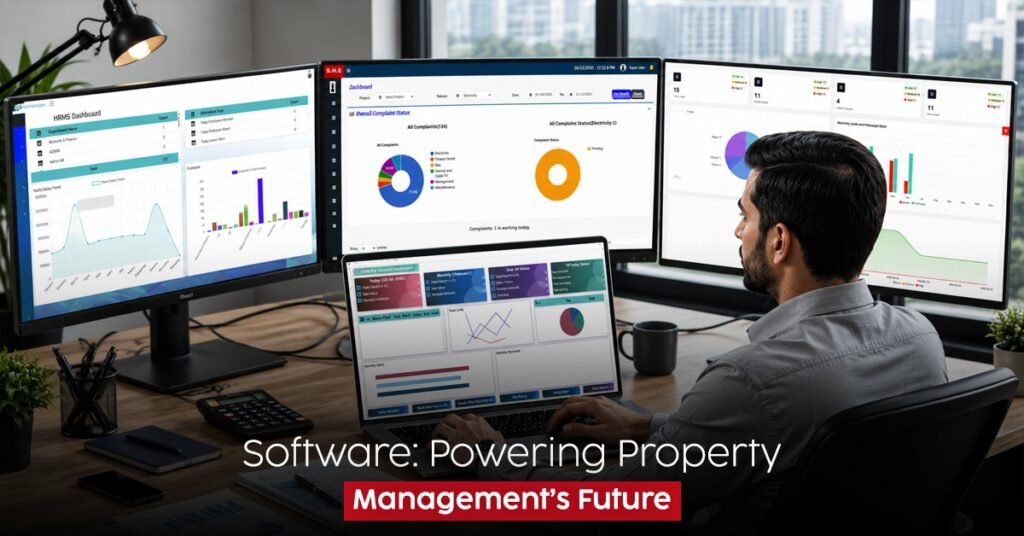
Modern property software can combine information together and introduce dashboards, reports, and analytics for managers to grasp what's going on throughout their portfolios. This can make it easier to see problems such as increasing maintenance expenses, vacancy rates, or overdue payments or upcoming leases.
AI has the potential to go a step beyond this, recognizing patterns that might not be immediately apparent to users. Studies in this area have examined the potential for AI to enhance the valuation and decision-making processes in the real estate sector and have highlighted the need for human oversight and trustworthy data.
By implementing automation, you can ease administrative pressures.
There are lots of repetitive processes and tasks in property management. Reminders of payments, updating records, scheduling maintenance, preparing documents, and routine information, etc., can waste a lot of staff time.
Organizations can set up workflows to help them perform these tasks with less manual involvement by using automation.
For instance, a system can automatically send out a notification to the tenant when rent is due, notify the staff when a lease is coming up, or pass a maintenance request to a different group. The small changes can make a big difference when multiplied by hundreds or thousands of properties.
It does not necessarily mean that the people need to be taken out of the process. Rather, automation frees up property professionals to be involved in decision-making, negotiation, relationship building, and strategic planning tasks.
The importance of integration is growing.
l One of the other major trends is the shift towards integrated property platforms.
l A property company can have its accounting, customer relationship management, leasing, maintenance, and document management systems separate. If these systems don't work well together, workers can be required to type the same data into various systems several times.
l These functions can be linked to each other using integrated property software to bring greater consistency in the flow of information across departments.
l It is especially relevant these days, when property businesses are seeking to scale up without escalating administrative efforts in tandem. As new operating platforms are introduced into the market, they are increasingly defining themselves as ‘centralized operating platforms', bringing together communications, finances and automation.
l Security and Human Oversight are still relevant.
l Along with the rise of AI and property software on the cloud, there are new duties to take on.
l Sensitive tenant information, financial records, contracts and business data can be found on property systems. Organizations require the proper access controls, authentication, security monitoring, backups and data-management policies, therefore.
l AI must be supervised as well. When making financial, tenant or compliance decisions, as well as other high-impact tasks, automated recommendations or actions should be carefully considered.
l The best tech solution is thus not likely to be totally automated. Rather, businesses can bring together the power of software and the hands-on skills of humans.
The Future of Property Software.The Future of Property Software.
Property is heading towards a software revolution beyond just transacting. The future of platforms will feature further integration of property management, financial operations, communication, analytics, automation and AI in increasingly connected spaces.
This change may help property companies find it easier to see, cut down on repetitive tasks, and enable quicker decision-making. However, it is not the technology that will ensure improved performance. Reliable data, well-designed workflows, employee training, security and clear business objectives will play a key role in successful adoption.
With the increasing complexity of property portfolios, software is increasingly part and parcel of modern real estate activities. The way forward for property management will most probably be those that are able to effectively mix digital efficiency with human judgement and customer-driven service.
FAQs
1. Identify the different types of property management software.
Property Management Software is a digital platform designed to assist property management businesses in handling property, tenants, real estate leases, payments, upkeep, paperwork, reporting, and more.
2. What are the ways AI is transforming property management software?
AI can assist in automating repetitive tasks like tenant communications, maintenance request processing, document analysis, reporting, and workflow management. It has shifted from providing basic support to automating tasks.
3. Is property software a solution to cut down on administration?
Yes. Reminders, workflows, reporting and centralized records can eliminate repetitive data entry and manual coordination, freeing up time for property teams to spend on more valuable tasks.
4. Why is it important to use integrated property software?
Integration links the data from various systems like leasing, accounting, maintenance, and tenant communication. This helps to decrease duplicate data and give managers a more comprehensive perspective of operations.
5. Can AI property software be used by all property businesses?
While AI can offer numerous advantages for property businesses, the specific types of applications will vary based on factors like portfolio size, operational needs, budget, data quality, and security requirements.