
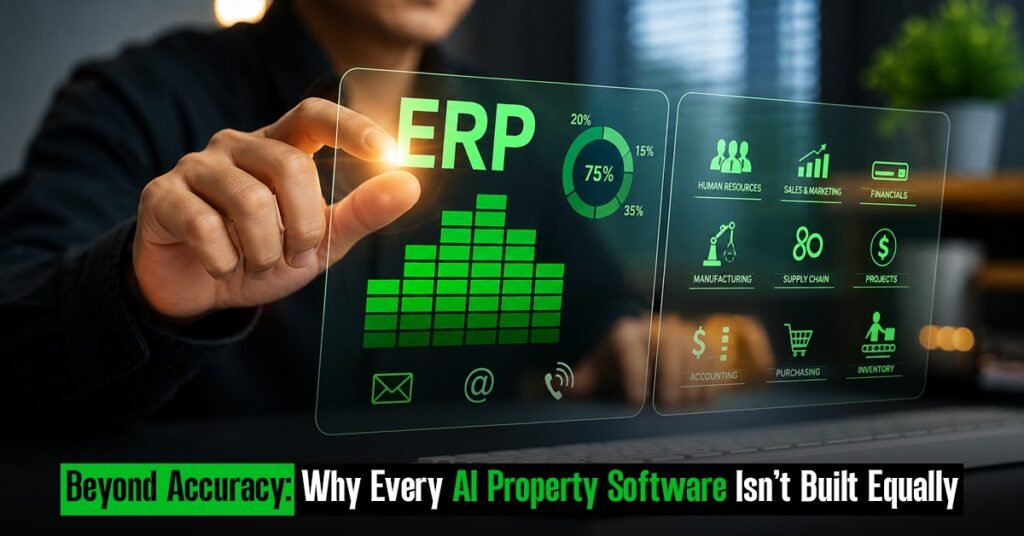
With the real estate market rapidly changing in the United States and globally, property businesses are turning to AI-powered real estate software to adapt their operations, improve customer experiences, and maximize profits. Whether it's an automated billing system or an intelligent CRM platform, AI holds the promise of speed, efficiency, and accuracy. But the accuracy trap is an emerging problem that many organisations are now encountering.
Not every AI-powered property software solution is the same. Many vendors will boast of high accuracy and smart automation, but it's not so straightforward. Companies that use only superficial commitments are likely to experience inefficiencies, data inaccuracies, and suboptimal decision-making results.
Understanding the Accuracy Trap
The “accuracy trap” happens when businesses believe that any AI system will provide them with accurate and consistent outcomes. When you're dealing with property management, it's essential to get it right, from numbers to tenant information to tracking leases and reporting. Small mistakes can result in significant issues with operations and finances.
Numerous property software providers leverage outdated or small datasets for their AI models. This means that their production might seem right, but they lack contextual knowledge. For instance, an AI billing system may accurately determine rent, but not consider local tax laws or specific payment arrangements.
Why isn't all AI property software alike?
1.“Data quality is a must.“Data quality is a critical factor.
The quality of data an AI system is trained on is crucial to its effectiveness. Advanced property software solutions leverage real-time, industry-specific, and diverse property-related data, whereas weaker property software solutions use general or static data. This has a direct effect on the predictive performance, reliability of reporting, and automation results.
2. Flexibility versus rigidity in automation.
The best property software is highly customized for the real estate industry—whether it be developers, agents, or property managers. Conversely, generic AI tools offer universal solutions that may not always cater to specific operational requirements.
3. Integration Capabilities
Leading property software integrates seamlessly with accounting systems, CRM platforms, banking APIs, and communication tools. Substandard systems are not integrated, causing disjointed processes and greater manual workload.
4. Foster compliance and local adaptability. Encourage compliance and local adaptability.
The laws governing land transactions differ from one state to another. Good AI property software can cater to the local compliance needs, the tax regime, and legalities. These details are often not considered by inferior systems, leaving compliance risks.
5. Continuous Learning vs. Static Models
AI systems are continually learning and adapting based on user interactions and new data. But there are a lot of low-quality platforms that are based on static models, which are soon outdated and which become less accurate over time.
The negative impact of inaccurate information on business.
Falling into the accuracy trap can have serious consequences for property businesses:
- Billing and reporting mistakes to the finance department
- 37% of customers cite incorrect data as a reason for a poor customer experience.
- Poorly functioning operation due to unreliable automation.
- Legal and tax compliance issues
- Loss of trust in technology systems
These problems underpin the need to carefully consider property software adoption prior to use, based on business needs rather than marketing claims.
The process of selecting the best AI property software available.
Businesses should be aware of the following to prevent falling into the accuracy trap:
Review data sources: Make sure that the software is based on real-time and industry-specific data sources
Search for flexibility: Select solutions that cater to real estate workflows
Review integrations: Check for compatibility with current systems
Test accuracy: Conduct pilot tests before implementation.
Check the credibility of the vendors: Collaborate with trusted vendors with proven track records.
Firms such as SHE Technologies are concentrating on providing property software that is reliable, scalable,e and accurate, tailored specifically for the real estate market. They focus on data accuracy, automation, and seamless integration, making them an ideal choice for businesses looking to grow efficiently.
The Future of AI in Property Software.The Future of AI in Property Software.
The property industry will be changing again in the near future with the advent of AI, but accuracy will be the key between good and bad results. Companies placing investments in good, smart systems will get an edge in competition, whilst companies using poor systems will suffer from inefficiency.
The lesson learned: AI can only be as good as the system that backs it. Selecting the right property software isn't only a technical choice; it's an investment in the long-term success of your business.
FAQs
1. What exactly is the accuracy trap of AI property software is what exactly?
The accuracy trap is the assumption that every AI system can deliver accurate and precise results, and if it's not, it can cause bad business decisions.
2. Why is accuracy crucial in property software?
Accuracy guarantees financial calculations, tenant data management, compliance, and overall operational efficiency.
3. What makes a quality property software?
Seek systems that have live data, customization, solid integrations,s and positive reviews from users.
4. What are the dangers posed by poor quality AI software?
Potential risks involve customer service, workflow, compliance, and financial mistakes.
5. Is it practical to implement AI in property software?
Yes, but only when you select a high-quality, reliable solution that suits your business's requirements and data quality.